
King John Seizes a Free Man. Chapter 39 Fires.
Magna Carta 1215 contains closed exception lists, a forty-day state machine, and proof chains down to the Latin phrase. Feed it facts, and it executes.
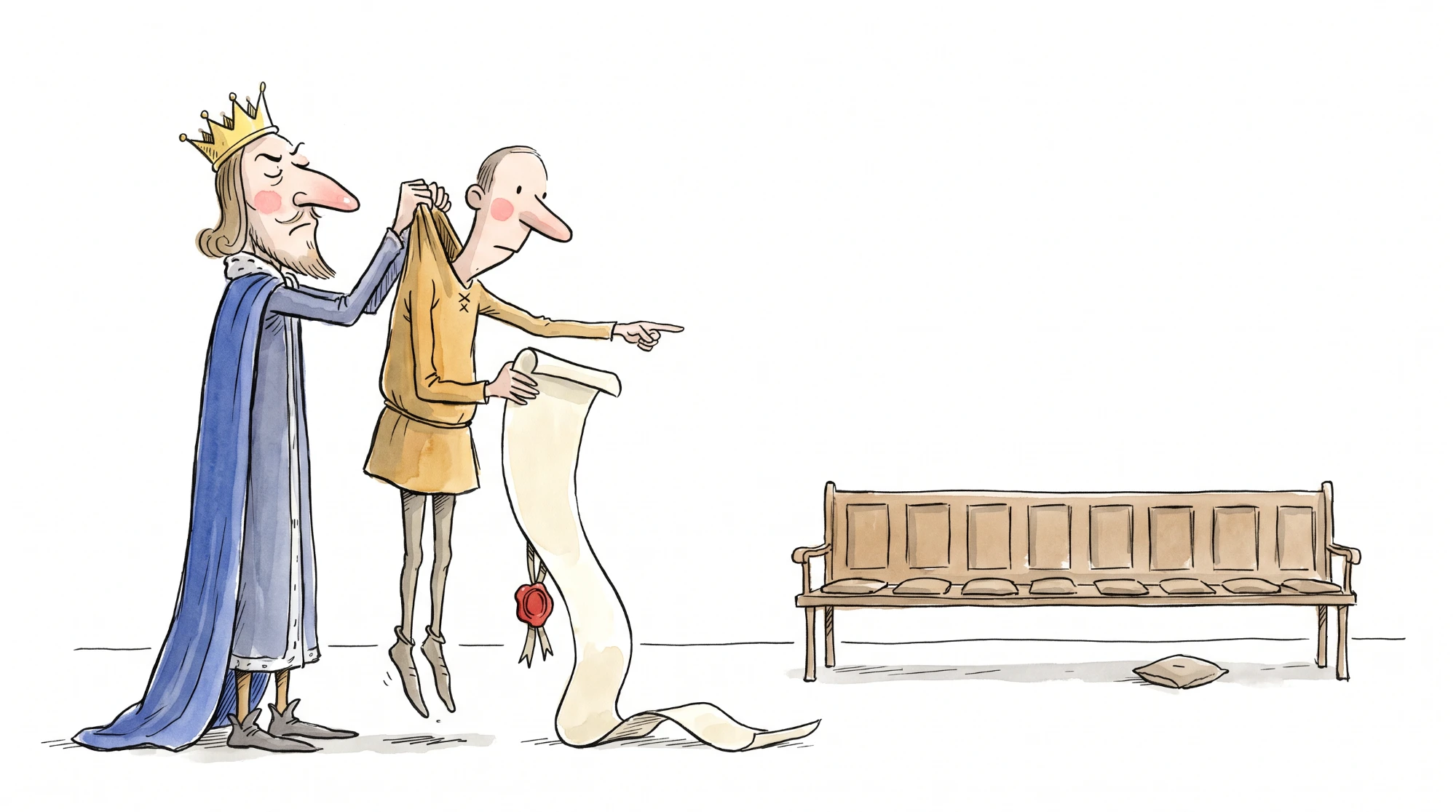
On 15 June 1215 the factual record on the marsh at Runnymede is brutally simple:
- The subject is a free man.
- The Crown has used physical coercion against him: seizure, imprisonment, or exile.
- The record contains no judgment of his peers, and no established law of the land.
What does the law say?
Run those facts through an executable model of Magna Carta and you do not get a three-paragraph essay on the spirit of British liberty. You get a derived legal state:
- the royal act is illegal coercion;
- the subject's immunity against royal force is active;
- the derivation cites Chapter 39 down to its Latin sentence.
The teaching case is named for Robert Fitzwalter, the rebellious baron King John outlawed before Runnymede. The model does not reconstruct his biography or argue medieval politics. It answers the procedural question the Latin asks: given these inputs, does the rule fire?
Chapter 39: two exceptions, or the act fails
Here is Chapter 39, pinned from Charles Bémont's 1892 critical recension (Stubbs numbering):
Nullus liber homo capiatur, vel imprisonetur, aut disseisiatur, aut utlagetur, aut exuletur, aut aliquo modo destruatur, nec super eum ibimus, nec super eum mittemus, nisi per legale judicium parium suorum vel per legem terre.
No free man shall be seized, imprisoned, disseised, outlawed, exiled, or destroyed, nor will we go against him or send against him, except by the lawful judgment of his peers or by the law of the land.
That nisi ("except") is a closed set of defences:
- lawful judgment of his peers, or
- the law of the land.
The free man does not have to prove that a trial never happened. The Crown has to establish that lawful process occurred. Missing evidence stays missing. If neither exception is in the record, royal coercion fails:
rule CoercionWithoutJudgmentOrLexTerrae(p: Person) strict {
    when free_man(p) and royal_coercive_act(p)
        and not_known(legal_judgment_of_peers(p))
        and not_known(law_of_the_land(p));
    then illegal_royal_coercion(p);
}The teaching case asserts two facts only: the man is free, and the Crown has used force. Ask whether the coercion is illegal. The engine returns a computed true, and the applied rule is Chapter 39.
This is not semantic similarity against an embedded PDF. It is a deduction grounded in a pinned thirteenth-century sentence.
Chapter 61: the forty-day enforcement engine
Chapter 39 defined the right. The barons did not trust King John to respect parchment. Chapter 61 — the security clause, forma securitatis — built the enforcement protocol.
Twenty-five barons were chosen to hold the monarch to account. If the King or his officers breached the charter, Chapter 61 prescribed an explicit sequence:
- Four barons notify the King (or the Chief Justiciar if the King is abroad) of the grievance.
- A grace period begins: forty days from notification (infra tempus quadraginta dierum).
- If the King remedies the breach within forty days, governance returns to normal.
- If forty days pass without redress, the twenty-five barons and the community of the realm are authorized to distrain the Crown by seizing royal castles, lands, and possessions.
- Even during distraint, the persons of the King, Queen, and their children remain inviolable (salva persona nostra).
The same sequence, evaluated at two timestamps:
Day 10. Four barons have served notice. The breach is unredressed. May the barons seize royal castles? Distraint is not due. Seizing property on day 10 is unlawful. The timer is still running.
Day 40. Four barons served notice, no redress, forty days elapsed. The state flips: distraint is authorized.
when four_barons_notified(b) and not_known(king_redressed(b)) and days < 40
then distraint_not_yet_due(b);

when four_barons_notified(b) and not_known(king_redressed(b)) and days >= 40
then authorized_distraint(b);
Eight centuries before distributed systems, the drafters wrote an escalation protocol with a timer, a fallback, and a personal immunity boundary.
Chapter 12: no taxation without common counsel
The same discipline governs Chapter 12:
Nullum scutagium vel auxilium ponatur in regno nostro, nisi per commune consilium regni nostri...
No scutage or aid shall be imposed in our kingdom unless by common counsel of our kingdom.
The Crown may not demand military commutation taxes (scutage) or emergency levies (aid) without the Common Council. The clause names exactly three exceptions: ransoming the King's person, knighting his eldest son, and marrying his eldest daughter once.
Any other levy demanded by unilateral royal decree evaluates to unauthorized scutage or aid.
Across all sixty-three chapters the mechanics stay consistent: closed lists of exceptions, negative defaults, and explicit temporal windows.
What medieval law teaches modern legal tech
Modern legal technology talk clusters around generative models and conversational interfaces. We prompt networks to summarize contracts or draft memos.
Running Magna Carta as formal rules names three structural facts that probabilistic systems do not resolve on their own:
- Law is relational and procedural. A legal answer is not a likelihood over words. It is a state transition when specific facts meet rigid preconditions.
- Negative conditions and temporal windows are first-class. Half of constitutional law turns on what did not happen (no peer judgment) and when it did not happen (the forty-day grace). A system that cannot reason over missing evidence and explicit deadlines cannot execute this kind of law.
- The proof is the deliverable. When a baron distrained a castle or a citizen resisted unlawful arrest, legitimacy came from the procedural record and the text of the pact. A derivation that exposes the applied rule, the missing exception, and the pinned sentence is an audit trail that can withstand dispute.
Arxo executes the canon. Models formalize; Arxo executes and proves.
The 1215 package formalizes all sixty-three chapters of Magna Carta (Stubbs numbering, Latin pinned to Bémont 1892). On 19 September 2026, all 104 authored test scenarios across the package passed under two independent evaluators. The Runnymede disputes — from Fitzwalter's imprisonment to the forty-day distraint — are executable teaching cases within the canon.
Magna Carta was never only a rhetorical monument. It was an enforceable operating contract with timeouts, fallbacks, and teeth. It was executable long before computers existed.
Explore executable canons at law.arxo.io.