
A Japanangka Cannot Marry a Napanangka. No Statute Says So.
Warlpiri skin law fits in eight names: a closed marriage table, two descent cycles, and a two-key rule over country. It was never written down, and it executes.
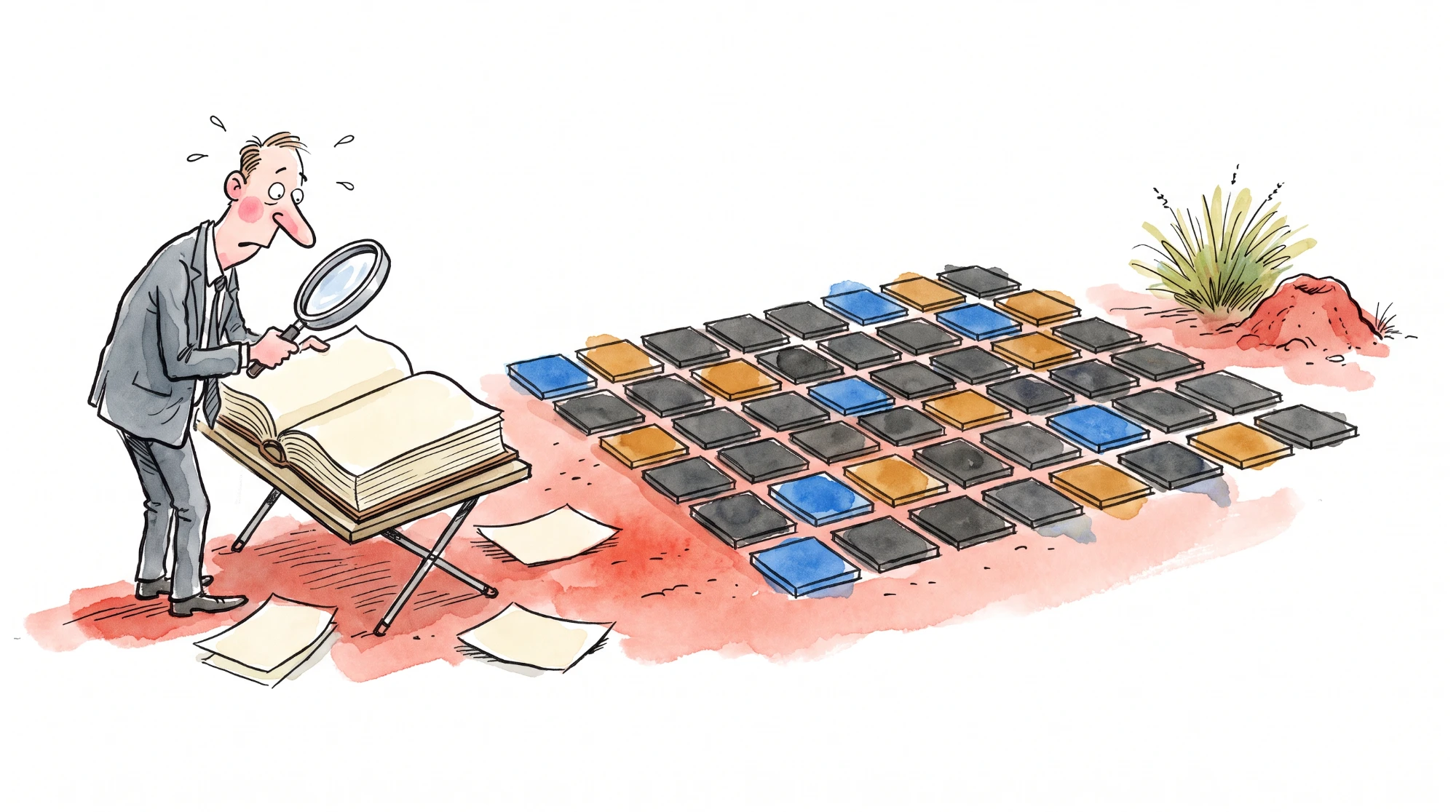
In the Tanami Desert of central Australia, a man and a woman ask whether they may marry. The record holds three facts:
- He is Japanangka.
- She is Napanangka.
- They are in a union.
What does the law say?
Run those facts through an executable model of Warlpiri kinship law and the answer comes back in one step:
- the union is a wrong-skin marriage;
- it is forbidden, and the evaluation reports the violated constraint;
- the derivation cites Article 6 of the restatement, down to its sentence.
There is no parliament behind this rule, no gazette, no clause number older than the model itself. Warlpiri people have carried the system in eight names and taught it child by child. The model runs a restatement compiled from published ethnography, chiefly Mervyn Meggitt's Desert People (1962) and Mary Laughren's work on Warlpiri kinship (1982); it holds the public structure of the system and none of the ceremonial knowledge that belongs to the community.
Magna Carta executes because its Latin is precise. This law executes without a text at all.
Eight names, sixty-four cells
Every Warlpiri person is born into one of eight subsections, called skins. Each has a male and a female name: Japanangka and Napanangka, Japangardi and Napangardi, Jungarrayi and Nungarrayi, Japaljarri and Napaljarri, Jampijinpa and Nampijinpa, Jangala and Nangala, Jupurrurla and Napurrurla, Jakamarra and Nakamarra.
A skin is not a surname and not a rank. It is a position. Once two people know each other's skin, they know what they are to each other: spouse, sibling, mother-in-law, custodian of whose country.
For marriage, the eight names make a table of eight husbands by eight wives. Every one of the sixty-four cells is filled:
- 8 preferred. A Japanangka man marries a Napurrurla woman; a Japaljarri man marries a Nakamarra.
- 8 alternate. The cross-cousin's skin: permitted, not preferred. Japanangka may marry Nangala.
- 48 forbidden. Everything else is wrong skin.
The table is symmetric. Read from the woman's side, every preferred cell is the same marriage, and so is every alternate one. The forbidden cells are written out one by one, not inferred from silence, so a wrong-skin union is a positive finding:
rule WrongSkinUnion(h: Person, w: Person, hs: Subsection, ws: Subsection) strict {
    when union_of(h, w) and sex_of(h, Male) and sex_of(w, Female)
        and subsection_of(h, hs) and subsection_of(w, ws)
        and wife_rank(hs, ws, RankForbidden);
    then wrong_skin_union(h, w);
}
The restatement records the prohibition and nothing more. It sets no tariff of punishment: what follows a wrong-skin marriage is a matter for the community, and the model stays silent where its sources are silent.
Two cycles name the child
A child does not take the skin of either parent. Two cycles assign it.
Through the father, skins alternate in pairs. A Japanangka man's children are Japangardi; a Japangardi man's children are Japanangka. The grandson returns to his grandfather's name.
Through the mother, skins turn in a cycle of four. Napanangka's children are Jakamarra; Nakamarra's children are Jungarrayi; Nungarrayi's are Jampijinpa; Nampijinpa's are Japanangka again. A woman's name comes back in her great-great-granddaughter.
In a preferred marriage the two cycles agree. A Japanangka father points to Japangardi. His Napurrurla wife points to Japangardi. The model derives the child's skin only when both cycles name the same class, and they always do, for all eight preferred pairs. That agreement is the reason the preferred cells sit where they sit. In an alternate marriage the cycles part, and the mother's cycle decides.
The same cycle carries the best-known rule of desert etiquette. A man must avoid his wife's mother: no direct speech, no sharing an enclosed place. The model does not need a list of mothers-in-law. It reads the mother cycle backwards from the wife's skin. A Japanangka man married to a Napurrurla woman must avoid Napaljarri women, because Napaljarri is the skin whose children are Jupurrurla. Give the model a man who addresses such a woman directly and it reports the avoidance broken, with Article 10 as the ground.
In 1949 the mathematician André Weil wrote an appendix to Lévi-Strauss's Elementary Structures of Kinship showing that marriage systems of this kind are permutation groups. The cycles above are that algebra, taught for generations as names.
Two keys to one country
Land follows the same names. Each country is held by a father–son pair of skins as kirda, its owners. The same country has kurdungurlu, its managers, drawn from the opposite half of society. English glosses them as bosses and policemen.
Neither can act alone. Kirda hold the power to initiate ceremony for their country. The power is valid only when kurdungurlu have consented:
rule KirdaMayInitiate(p: Person, c: Country) defeasible {
    when kirda_of(p, c) and kurdungurlu_has_consented(c);
    then power InitiateCeremony {
        holder p;
        exercise ceremony_initiated(p, c);
        valid_when kurdungurlu_has_consented(c);
        effect ceremony_effected(p, c);
    };
}
And the managers are protected in turn: kurdungurlu hold an immunity against any ceremony that would take effect without them.
Constitutional lawyers call this a separation of powers with a veto. Here it is two rules, a power and an immunity, and the model decides who holds which from nothing but a person's skin and the country in question.
What an unwritten law teaches
Legal technology assumes that law is text: parse the statute, embed the clauses, retrieve the paragraph. Warlpiri skin law has no paragraphs to retrieve, and it is more exact than most statutes.
- A canon is its structure, not its medium. The table has sixty-four cells whether it is printed, sung, or held in the names people call each other every day.
- Closed tables beat open prose. Every pair of skins has an answer. There is no gap to interpret and no ambiguity to litigate; the hard questions are about facts, as they should be.
- Execution preserves the grounds. Each answer arrives with the rule applied, the facts used, and the article of the restatement behind it, so a reader can check the model against the ethnography line by line.
Arxo executes the canon. Models formalize; Arxo executes and proves.
The Warlpiri package formalizes twelve articles of the restatement: the eight skins, the marriage table, both descent cycles, avoidance of the wife's mother, and kirda and kurdungurlu. On 20 September 2026 all 18 authored test scenarios passed under two independent evaluators.
A law can run for generations with no writing at all, provided it is exact. This one is.
Explore executable canons at law.arxo.io.